Grab this ridiculously fabulous example of early 1990s Arabic art song here.
Watch a two-minute excerpt from a rare live performance of the title song:
One of the best things about moving is unpacking. Because I've just moved from a relatively large apartment to a fairly small one, I'm having to (a) unpack slowly and (b) make a lot of tough decisions about what stays and what, soon, will have to go. This has been good for me because, if I'm going to be perfectly honest with you, there are a lot of CDs here that I haven't yet really listened to. Tonight's offering is one of them. Had I listened to it earlier, I would have posted it long ago. I don't even know how to describe this album, which consists of two songs, the 47-minute-long "La Ya Sadiki" ("Babel") and the 4-minute "Ya Rayeh Lebnan." Kazim al Saher composes a lot -- perhaps all -- of his music, and it's entirely possible these two songs are his. If so, the man is a genius. Not that I didn't already think that about him. I did. But the title song of this 1993 album is as mind-blowingly intricate as it is expressive -- and if you know al Saher's music, you know you can pretty much always count on the latter. I've got a bit of news to share with you all, but I'm going to save it for later. Right now, a dozen-plus boxes are calling me, waiting to be unpacked, their contents sorted, their fates decided upon.
Listen to "Mas Caliente Que El Sol" Grab this record here. Didja miss me? Well, I certainly missed you. Yes, I DID oogie woogie oogie-oogie. *Cough*. Hello? No, wait, come back. I won't do that again; I promise. So. I've been very busy this month: I moved. No, not to Buenos Aires or Bangkok or Tower Records Shibuya. I'm still in Astoria, but closer to Manhattan, closer to my midtown job and--most importantly--closer to the Almighty 7 Train ... or, as I like to call it: So Big Metal Sky Snake What Takes Me To Many CDs of a Delightful "Foreign Music" Nature. Or maybe I'm in Long Island City? Honestly, I don't know because every other map I look at has completely different borders for each Queens "city." Let me put it this way: I haven't been so excited about where I'm living since I moved to NYC in 1997. I'm still unboxing things, which is why I haven't really added anything to the Bodega shelves since September. And also why, if you've requested a reup, I haven't yet gotten to it. (Note to Self: Next move, clearly label what's in each box.) But last weekend I took a long walk around the new neighborhood and, in addition to somehow convincing the woman working at Tacos Mexico to bring me her mother's recipe for nopales (cactus), I discovered a vast warehouse of Latin CDs, mostly from Mexico, priced to move at three for $10, including tonight's thrilling offering. Fobia was founded in the late 1980s and were part of the Rock en Español wave, largely influenced by the American and British New Wave, including Caifanes, Los Amantes de Lola, Maldita Vecindad y los Hijos del Quinto Patio,Maná, and Neón. True to their name, Fobia's lyrics shied away from the more socio-political leanings of their counterparts, favoring exploration of band members' personal fears and unhealthy obsessions. The band recorded five albums in the 90s, split up, then regrouped in 2004. Tonight's offering includes tracks from the band's first decade along with a few songs cut the year they got back together.
I've reupped this 27-song collection by special request, here.
[Originally posted in November 2012.] GARY'S NOTE: For months now, a fellow traveler currently in Seoul, South Korea, calling himself "Male Cousin," has been promising to send me a mix of new and old pop, folk, rock and indie music from his host country. Last week Male Cousin sent along the finished product: 27 songs that prove to us that there's much more going on in Daehan Minguk than K-pop and PSY. His introduction follows:
Koreans love music. As one of my friend’s students explained, “We are a sing-song culture.” There are singing rooms literally everywhere, in every city, no matter how small. Often, in Seoul, there are more than five within eyesight, and there aren’t just singing rooms. There are request bars (where you request the songs you want to hear), vinyl bars (specializing in music from the sixties through the nineties in Korean and English), even band themed bars (one of my favorite bars is called The Cure and only plays new wave music over an endless loop of Cure video projections). In Seoul, there is a bar for every taste, no matter how obscure. Then there’s K-pop. Jesus, K-pop. Thanks to PSY (the most unlikely spokesperson for such a heavily manufactured and meticulously crafted “genre”) people in nearly every country on this planet have heard of it. It’s that incessantly catchy club music with the lyrics-you-can’t-understand-but-don’t-mind. It’s mindless. It simply works. And yes, in Korea, it is EVERYWHERE. It’s in the malls, the corner stores, the coffee shops, the boutiques, the taxicabs, it’s even piped into some of the parks. It’s entirely unavoidable. Eventually (thank god) it just becomes background noise, you can tune in and tune out. But the ubiquitousness of K-pop is mostly a post-millennial phenomenon. There were pop stars in the 80’s and 90’s, but cut from a very different cloth. These pop stars, in addition to being in many cases actual songwriters, occupied the radio waves with the remnants of an earlier, more diverse group of Korean musicians. See, in the late 60’s through the 80’s Korea’s music got wonderfully bent. The war was over. There was more interaction with the west and its sounds. There were Koreans and Americans playing music together, western music on the radio. And to top it off, there was a repressive military dictatorship to protest against. For a couple decades there was an explosion of raw creativity here as Korean musicians began taking cues from psychedelic rock, funk, disco, and, later, new wave. They adapted, made discoveries, and wound up with some beautiful hybrids that still deserve attention today. However, under the military regime, a lot of this music was banned as subversive. It still existed, and was passed around fairly openly. Sang Ul Lim, for instance, is still a household name; some say they were the Korean Beatles. But as Korea modernized, so did the record companies. And in the past decade and a half, they have been
so effective at cornering the market, utilizing a by-the-numbers pop equation that always seems to hit, that they have almost completely wiped out the rich history of the previous three decades. In some sense K-pop is the true representation of music in Korea. It accounts for nearly four billion dollars of the country’s economy, and for many of my students, it is all they know or care to know. There are some musicians here that wish that this particular part of their musical history had played out differently. The music in this mix is meant to be a sampling of the (de-facto underground) Korean music scene, as it exists at this very moment, with a handful of songs from the 60’s-90’s thrown in as reference points. There are hipster chillwavers, post-rockers, folk artists, shoegazers, weirdoes, punks, electronic experimentalists, drone metalheads, and indie poppers all making unique and wonderful music within a dominant culture that doesn’t respect difference when it comes to musical taste. They are, to use a Korean idiom, “throwing egg at a rock.” This collection is imperfect, and obviously slanted to my tastes and exposure, but nonetheless offers a glimpse at some of richness that exists here, if you just know where to look. Male Cousin teaches at a university in South Korea. Read more about the bands in this mix on his blog here.
Reupped in case you missed it the first time, here. Originally posted in December 2012.
Listen to track 1
INTERVIEWER: What do you think of this first bit? RESPONDENT: It's like this chick is smashing a car when she might be singing a song about "I love you, baby." Is she saying the car is evil and the music is in "the" background? It's like she's out there reading poetry with this little green and gold robe on while smashing an M.G. ...
Listen to track 7 INTERVIEWER: Have you heard this one before? RESPONDENT: I've heard the beautiful lights but they don’t sound like they did before. This is nicer, a nice little cat in her own groove, all about flowers and people wearing golden underwear. I like that nobody is going to listen to it. It's really groovy, but her group ought to be a little less creative. These days everybody thinks everybody else has to have trips, and people are singing about trips. Listen to track 8 INTERVIEWER: She's just making up words at this point. RESPONDENT: Yeah, it's like we're all being filmed. As we listen to it, shivering, the night and the ice descend. The chill air maybe picks this one up. Like this was not part of the formal trip, so she could just rap, because this isn't where she is at all. And that--that's where we're going, man. [Don't miss Bodega Pop's 10 Best Albums of 2012.]
Totally fabulously fucked up first track from this super great CD Reupped by popular demand, here. [Originally posted in July 2010.] Found somewhere on the Bowery. Oh God I love Fama. And I especially love the first track on this CD, "温故知新." I mean, OMFG, how many time changes are there in this? How many things have they collage-crammed into it? It's just ... spectacular. I could be wrong, but I think the title involves some sort of word-play involving "feng shui," which can be literally translated "wind and water" ... right?
Grab it here. Found today in the Nile Deli on Steinway Street while out on a long walk in the neighborhood. A composer, singer and actor, Fawzi was born in 1918 in Tanta, the fifth most populous city in Egypt, about an hour and a half north by car from Cairo. By the age of 12 he was already making a name for himself as a wedding singer, but his father disapproved; he more or less ran away to Cairo to make it in the music industry. He landed a gig with Egyptian Radio and then launched his acting career in 1944. His most famous composition might be the Algerian national anthem (the lyrics were written by Mufdi Zakariah while imprisoned by the French).
Listen to "Abe Kaku"
Listen to "Mondo"
Grab the whole shebang here. Awesome gypsy music from a label in Istanbul. One of a series of similar albums I picked up at Uludag Video (1922 Avenue W) in Sheepshead Bay Brooklyn. If you like, let me know and I'll upload the others. (They're not all gypsy, fwiw.)
Reupped in 320 glorious KBPS, here. Listen to the fabulous fifth track
[Originally posted on March 15, 2012.] Why anyone would listen to 20th century western classical/avant garde music when Burma exists is beyond me. Well, okay; in all seriousness: There really isn't any music quite like Burmese, at least Burmese music toward the more folk end of the spectrum. (They do, like everyone else on planet Earth, have their own brand of western-influenced pop and rap.)
As regular readers of this blog may remember, last August, Peter Doolan, who curates the insanely great Monrakplengthai , invited me out to visit Thiri Video, a Burmese media store in Elmhurst, Queens, that he'd gotten wind of a few weeks prior to contacting me. (Get the CD I found that day here.)
It took us well over half an hour to find the place, and this was after we had already unwittingly passed it. It turns out there is no store front; it's actually in a garden-level apartment. After confirming that we were, finally, at the right place, we removed our shoes and went in.
There is nothing like Thiri Video anywhere else in New York--at least, not that I'm aware of. I'm guessing there's nothing like it in the rest of the U.S. as well. (Please correct me if wrong; and include an address, as I would love to visit it, if it exists.)
Rather than rely on my groggy descriptive capabilities (it is, after all, not quite 5:00 a.m. as I write this), let's take a look at Thiri Video's promotional video, shall we?
I love that video. If my exhortations thus far were not enough to get you to watch it, or if a lack of subtitles frightens and intimidates you, I'll explain: A young Burmese man and what I gather are his or his girlfriend/wife's parents check out the time and wonder where Dude's significant other could possibly be.
As often happens in this kind of situation, a woman bathed in eerie blue light, whose midsection has been replaced with a midriff-sized chunk of silver, drops by, telling the young man to forget his bride/bride-to-be, and regaling him and the rest of the family with tales of Thiri Video (including numerous shots of the shop). Obviously, he doesn't, at least at first, believe her. For how could such a Paradise on Earth exist, even in fabulous Elmhurst, Queens?
Well, I'm here to emphatically tell you that it does, indeed, exist, as I just visited it for the second time last Sunday. I'm also here to offer you one of the most insane, shit-eating-grin-fabulous CDs I've ever found anywhere.
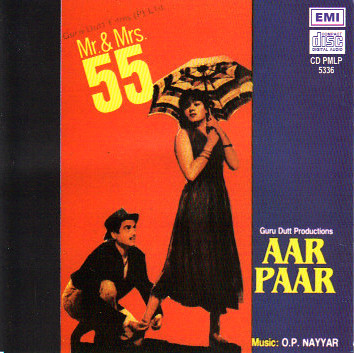
Reupped by reader request, here. No idea where I got this. I have hundreds of Bollywood soundtracks, mostly from Jackson Heights, Queens, although I picked up a few on Coney Island Avenue in Brooklyn and in Edison, New Jersey. This, without question, is one of my favorites. O.P. Nayyar was the only successful Bollywood composer who never, ever worked with Lata Mangeshkar; it's said he was largely responsible for giving Geeta Dutt, Mohamad Rafi and, especially, Lata's sister, Asha Bhosle, their careers. Whatever the case, he wrote some of the hottest pop music, from any culture, throughout the 50s, 60s and early 70s. "Mr. & Mrs. 55" is not my favorite Guru Dutt movie, but it's pretty great, and features, in addition to the fabulous Madhubala as a feminist, Dutt himself as a cartoonist. (In one of the most famous exchanges from the film, a new acquaintance asks: "Tum communist?" (("Are you a communist?")) "Ji nahin. Cartoonist." (("No. Cartoonist."))) "Aar Paar," a far less interesting film, does however feature what I believe is the single most remixed song of all time, and this from the most remix happy culture on earth: Shamshad Begum singing "Kabhi Aar Kabhi Paar":
Repped, B-cuz it B so speshul, aqui. (Also, I was bragging about the circumstances under which I'd found it to some friends at dinner after the NY Art Book Fair this weekend.)
Listen to "Quai No. 3"
Listen to "Perfect Stranger"
[Originally posted August 5, 2012.] This album, Arthur H's first, is 23 years old. Imagine! We've been deprived of this unimpeachably sublime record for more than two decades. Why? We don't need to hear the damned Buena Vista Social Club every time we order an Americano, do we? I love Monk and Mingus as much as anyone, but, really, is that all you can play in your used bookstore, Mr. Used Bookstore Owner?
Please let's do everyone around us a favor and, instead of just grabbing this delicious CD and grooving to it at home while reading Natsuo Kirino's Out or whatever, let's all take the extra few minutes to transfer the thing to a flash drive and share it with the awesome people who run the cafes and bookstores in our neighborhoods. Yes?
Arthur H, born in Paris in 1966, spent much of the 1980s traveling around the West Indies and studying music in Boston before returning to France where he began to perform live in 1988. Clearly influenced by Serge Gainsbourg and Tom Waits, his style is instantly recognizable and, ultimately, all his own.
It's unfathomable to me that he's little known outside of France. I'm guessing many of you will feel the same, as at least a couple of you asked to hear more of his music a few weeks ago when I posted this.
As is clear from the scan above, this copy was previously held by the library of the Alliance Francaise; I picked it up at Bastille Day on 60th Street for a mere 25 cents.
MARY ANN
-
This sounds like some dead ass '90s "melodic hardcore" aka "skate punk"
formed from the solidified drippings of the Fat scene that oozed into every
in...
TH#114 ~ RED ROSE ~ Luke's Spring 26 Tape
-
Here's our new seasonal selection of gems from all around to fit onto a C60
*musicassette* - hope you dig it! If for personal reasons you don't listen ...
John Denver – Take Me To Tomorrow (LP 1970)
-
*AQUI:*
*John Denver – Take Me To Tomorrow *(LP RCA Victor – LSP-4278, Maio de
1970).
*Produtor*: Milton Okun.
*Género*: Rock, Folk, Country Rock, Pop ...
Judah Eskender Tafari - Life
-
Black Redemption LP 2020 FLAC
Produced by UK Sound System men King Earthquake (Side A) and Word Sound &
Power (Side B).
Last track Jah Army and its versi...
Ammar El Shariy'i عمار الشريعي
-
Mohamed Ibrahim Ali El Shariy'i, known as Ammar El Shariy'i, was an
Egyptian musician, composer, arranger, and critic born on April 16, 1948,
in the...
More Mileage From Raiss Hmad Amentague
-
Here's another cassette of *amarg souss* from Raiss Hmad Amentague. Unlike the
cassette we shared last week, this one does not sound like it has been
sou...
Slurpy Gloop – I Heard It In A Bathtub In Ohio LP
-
Just a quick post today to share an updated rip of this minimal
synth/experimental/psychedelic classic from 1986. Slurpy Gloop were a
four-piece band from ...
Resonance FM 15/03/26
-
*Dig That Treasure (15/03/26)*
Wendy Eisenberg - Old Myth Dying
Iivana Mišukka & Arja Kastinen - Vanha polkka
Maria BC - The Sound
Mahogany - Chance
Theodo...
Alice Coltrane - Universal Consciousness (1971)
-
Recorded between April and June of 1971, Alice Coltrane's "Universal
Consciousness" stands as her classic work. As a testament to the
articulation of her...
MICHEL PORTAL R.I.P. (1935-2026)
-
MICHEL PORTAL QUINTET "PARIS 68-01-20"
Michel Portal, tenor saxophone, bass clarinet
Joachim Kühn, piano
Barre Phillips, double bass
Jean-François Je...
Spotlight on THE ANTARTICS - by Ghaz, KL
-
Here's another informative article about the legendary band, The Antartics
(sic), written by Pop Yeh Yeh historian, Ghaz!
*THE ANTARTICS – FROM ENGLI...
Destabilisierende Aktionspotenziale
-
(*Stereophonic Space Sound Unlimited* is a Swiss instrumental duo which
toys with influences of surf, electronics, library, and space age/exotica,
form...
Fondering - Black music from the Surinam forest
-
Another tape i bought in the year 2K.
Sweet singing and drumming from descendants of the Surinam marroons. Fawaka!
Fondering uit Suriname
Dit is een he...
11/23『潜行一千里 ILHA FORMOSA』トークショー@K'S CINEMA
-
『潜行一千里 ILHA
FORMOSA』16:50の回上映後に空族とトークショーをおこないます。18:50から上映される『バンコクナイツ』と合わせてどうぞ!
https://www.ks-cinema.com/movie/senkoissenriilhaformosa/
the dust of all this
-
there’s simply no way to write without laying waste to all of existence in
order to choose what to bring back from the dust of all this — *is this
what is ...
Two from the American Southwest
-
I wanted to focus on two examples of local, almost “one-off” 78 rpm
releases that feature music of the American southwest, in the states of
Arizona and New...
march 16, 2025
-
oscar peterson & dizzy gillespie - caravan
cave - arrow's myth
freakingsnap - live at king cob market pub march 12, 2025 (excerpt)
zinnia - night be min...
Ana Orsini’s Sudden Demise Saddened Her Colleagues
-
Ana Orsini, In the wake of the devastating information, friends, circle of
relatives, and fanatics have been paying their respects to the beloved CBS
infor...
This is the end of the road.
-
Thank you everyone who has visited and followed this blog and its
predecessor (Washerman’s Dog) since 2010! I have run out of steam and will
be taking time...
tac - Next
-
*A comment hit out of the blue but at an opportune time. If you missed this
majestic collection first time around, you are forgiven.*
Maybe you haven't...
TEN IN TWO
-
VARIOUS ARTISTS - Ten In Two
Tracklist: 1 - The Edge - David McCallum 2 - Soran Bushi - Kifu Mitsuhashi
/ Kiyoshi Yamaya 3 - The World Is A Ghetto - The Al...
Elliott Smith Basement Remodel
-
Since the poor dead bastard's unfinished basement was completed by others
to their own design, here's my take, which is obviously better because it's...
R.I.P. this blog (and hello new zine!)
-
As anyone who still occasionally checks into this site will have noticed,
updates over the past few years have gone from sporadic to almost
non-existent. T...
QUATSCHPARADE
-
I´m still buying way too many records. Here are just a bunch of (mostly)
German Novelty 45s that I found this week. Some I had been looking for for
a long ...
How I Became An Expert on
-
Realty Lawyer – Why You Should Use One in your house Purchaser Lawsuit What
does a property lawyer do? An attorney spends their job assisting people
obtain...
T.P. POLY-RYTHMO & Avolonto Honoré
-
Some artists have marked music like like Honoré Avolonto and his particular
way of singing, especially on afrobeat. "E So Plait Mi A" is, for me, one
of...
New Donation Channel on Bandcamp
-
Pada tanggal 21-22 Juni 2019 Gabber Modus Operandi akan tampil dalam
program Night Mass di festival musik eksperimental internasional Dark Mofo
yang digela...
Akina Nakamori – Fushigi (1986)
-
After a month laying low due to restrictions on some platforms, we’re back!
You probably are seeing some reposts and more will come along the way,
these ar...
Farewell, "Evil Genius"
-
Dr. Victor Abimbola Olaiya, known as the "Evil Genius" of Nigerian Highlife
music, passed away Wednesday, February 12, at the age of 89. Thus ends an
er...
Ambiance Congo: February 2, 2020
-
WELCOME!
Thanks again to listeners who requested to hear some of their favorite
songs! The first few songs today fill those requests.
We also have, for thos...
Kalyanji Anandji: Aamne Saamne (1967)
-
[image: Aamne Saamne]
Kalyanji Anandji's 1960s output isn't generally as immediately
attention-grabbing as that from the following decade, yet as has been ...
Various Artists - The Mozart Lounge (2002)
-
Well, here I am again with a random post after 18 months or so. This time
one of my favourite albums, the 2002 Mozart Lounge compilation from
Apoll...
Bagaimana cara menjadi pemain Dewa poker online?
-
Untuk game God of Poker Online, banyak yang dicintai dan menjadi game
favorit pemain. Karena gaya permainan untuk pemain cukup rumit dan
menuntut, itu meng...
The Moonstrucks
-
The Moonstrucks were fondly styled as the original Pinoy “Campus Darlings”
from Manila, Philippines. The lineup variedly consisted of Alfredo Lozano
Jr – f...
MUTANT SOUNDS VINYL AUCTIONS ON EBAY ARE LIVE NOW
-
Just a small update to let everyone know that some major vinyl rarities
from the Mutant Sound archive are being auctioned currently and auctions
will be co...
Le Poète
-
Only a year ago we celebrated his 80th birthday with a selection of his work,
today we mourn his death.
There are no words for the sadness, the loss, felt ...
We Won't Forget You...
-
Dengbej Gazin Dengbej Gazin was a singer from Van in eastern Anatolia, she
belongs to a tradition of storytelling through chanting. Consider for
example...
Tip For Choosing a Good Driving School
-
Once you sit behind the wheels ready to start a car, you must be ready for
the tremendous responsibility that you are about to take over. The
knowledge o...
Yamoah's Band
-
And once again a 'new'album from my favourite band, Yamoah's.
It dates from 1975, so it is hardly new, and probably the music is even
older. But i had ne...
Membasmi Kutu Kucing Dengan Minyak Telon
-
Jika kucing Anda membenci air, coba gunakan sisir kutu agar membasmi kutu
kucing dengan minyak telon merasa tidak nyaman. Anda perlu memastikan sisir
turun...
Ngixolele: Forgive me
-
Amongst year-end reflections of gratitude and disappointment the question
of forgiveness keeps coming back to me. Those who seek it, those who give
it, ...
Field Report: Richmond Folk Festival
-
Feature image above: Victor “Bitori” Tavares. Photos by Charles “DJ
Graybeard” Williams. The Richmond Folk Festival might not get a lot of hype
outside of ...
矢野顕子 – JAPANESE GIRL [1976]
-
矢野顕子 (Akiko Yano) is one of my most favorite artists I’ve discovered since
Midori. Wild, jazzy and genre-hopping much like Midori, she’ll go from
using syn...
Arabic Sleeves with Children Scribbles
-
We found these sleeves a while ago.. All scribbled ! First one is egyptian,
as I know. All the following is from Morocco, Casaphone from Casablanca and
Bou...
goodbye, 8tracks
-
I've started a project of daily music selections on Twitter at
*#hearsaysongoftheday*.
I hope you check those out. Let's see how this goes.
The post goo...
Anri (杏里) MOANA LANI Album
-
Here is Anri's MOANA LANI album. It was released on June 24, 1992.
1. PAPAYA PAPAIA
2. KOHOLA TAIL
3. Ai wa Dare no Monodemonaku (愛は誰のものでもなく)
4. Saigo no ...
ZOOGZ TOOSDAY: Son Of Puke
-
It's the (slight) return of Zoogz Toozday!
Like a cross between cartoon soundtracks and free jazz, side 1 of this 1987
cassette-only release is a sprawling...
Australian Jazz Quintet + 1 (1957)
-
The Australian Jazz Quintet (also confusingly known as The Australian Jazz
Quartet) were an old-school cool jazz act that achieved success both in
their...
Dhafer Youssef – 2016 – Diwan of Beauty and Odd
-
Dhafer Youssef‘s album “Diwan of Beauty and Odd” carries all the
trademarks this exceptional artist is known for: beautiful melodies,
heartfelt chanting ...
TV-FREAK NIGHT SAMPLER
-
Not original cover art
Artista: Young Punch, Gelugugu, Banana boat, With my foot, Xarts, Going
Steady, Potshot, Panic, Mike Park
Album : TV-Freak Night S...
Livro "Lindo Sonho Delirante"
-
Olha só que legal! Recebi um email do Bento Araújo, que por muitos anos
publicou a revista Poeira Zine. Ele está finalizando o livro *Lindo Sonho
Delir...
New blog on Peru: Mon Pérou
-
I invite you to check our new blog, in French, on Peru: peruvian culture,
music, art, history, travels, food ... from the street art of Jade rivera,
recip...
Gnawa - all the SCP uploads
-
It's been a long time since there's been any activity over here at Snap,
Crackle and Pop, but I thought it might be a good moment to start
consolidating...
Papers for the Border Episode 2.2
-
We hit the ground running and we’re still going strong, inspired this time
largely by Paul Bowles’s recordings of Moroccan music. Here is the link to
the p...
fragments d'un underground berrichon [video]
-
Fragments d'un Underground berrichon (1965-2013) from chateauroux
underground on Vimeo.
45 minutes movie, from the underground/experimental/artistic scen...
► Steve Beresford - The Bath of Surprise (1977-80)
-
[CD: Amoebic/Valve, Japan, Dec. 1999; #AMO-VA-03
- LP originally released by Piano, UK, 1980; #PIANO 003]
Steve Beresford: all instruments
01. Punctuati...
HELEN - "THE ORIGINAL FACES" (2015)
-
H *Liz Harris* των *grouper* είναι από τους μουσικούς που δοκιμάζουν
συνεχώς διαφορετικά είδη μουσικής, δίχως να μένει προσκολλημένη σε έναν ήχο
ή σε ένα ...
Various - Caribbean Soul (2015)
-
01 - king stitt - sauvett (dance hall '63)
02 - the mighty sparrow & byron lee - try a little tenderness
03 - esso steel band - killing me softly
04 - len...
Scotty Scott and his Vanity 45 (MP3's)
-
The Film City label is one which utterly fascinates me. It was the label
Sandy Stanton created after The Fabulous Fable Label, which I've written
about her...
Annual Japan Nite info post
-
Japan Nite is celebrating its 20th anniversary starting tonight in Austin.
The headliners for this tour are TsuShiMaMire, QUORUM and The fin. Learn
more ab...
THE END
-
Sorry keeping some of you on tenterhooks wondering whether Boot Sale Sounds
is still a going concern. I was hoping to get back into uploading some gems
fr...
Uncover Valuable and Semi Jewels
-
Semi Jewels - Any mineral substance that's listed at its charm and/or its
strength may just like a gems. You'll find several kinds of gems for
instance rub...
Hiroshi Sato - Super Market (1976)
-
Some readers may know the late Japanese pianist Hiroshi Sato from his
excellent *Awakening* record with Wendy Matthews, or his work with ...
Faktor Penyebab Kanker Payudara
-
*Penyebab kanker payudara* belum sepenuhnya dipahami, sehingga sulit untuk
mengatakan mengapa seorang wanita dapat mengembangkan kanker payudara dan
wanita...
A Chinese Ghost Story Soundtrack (倩女幽魂) [REPOST]
-
*As I've posted several times before, I am a huge Hong Kong movie fan and
"A Chinese Ghost Story" is definitely on my favorites list. While Tsui
Hark's "Z...
Subway - Subway (1972)
-
*Subway - Subway (1972)*
A beautiful and very rare album from the annals of European
psychedelic/folk/prog circa 1972. Subway were a half American, half...
Age Factory
-
*手を振る*
Посмотрев, несколько раз подряд, клип на песню 真空から - стал долго и упорно
ждать их мини альбом. Ждать пришлось чуть больше двух недель. Оправдал ли ...
-
Hopefully all the links have now finally been refreshed and replaced with
working ones at a new service. If you still find missing or malfunctioning
on...
MC Swat - We Don't Want
-
*MC Swat - We Don't Want*
*مانبوش - ام سي سوات*
*Libya*
Released May 2, 2012
Source: https://www.youtube.com/watch?v=v_TOS1ubAG4
Click here to download the ...
Sounds of the Streets: Istanbul
-
In September 2013 I visited Istanbul for the first time with the hopes of
recording street musicians and any other interesting sounds I could find
along t...
New Latin But Cool Vinyl Coming Out
-
*ANA TIJOUX-Vengo (Nacional Records, 2014)*: For a while, after her
departure from *Makiza*, I remember *Ana Tijoux* was trying to detach
herself from the...
The Soap: "My God, That Feels So Good!"
-
1.- Discotic
2.- We go
3.- Wait a bit
4.- 24
5.- Cheese Boy
6.- Las Vegas
7.- Street
8.- What’t up your ass?
No sé para que escribo nada si solo os vais ...
HELL ON HEELS - Dogs, Records & Wine (2007)
-
When Bomp impresario Greg Shaw first heard Hell on Heels, an all-woman
four-person garage band out of Phoenix, Arizona, he told one reporter, “I
feel th...
New Favorite Blog - Stack o' Sides
-
Ok folks, so I don't get much time on the internet these days, what with
living off-grid and all. But I just discovered that one of my favorite
musicians, ...
And We Danced
-
*Celia Cruz con la Sonora Matancera*
*La Tierna, Conmovedera, Bamboleadora*
Seeco, SCLP 9246, made in New York
Hope you all had a good Thanksgiving weeken...
"Cries for Help" original art | SOLD
-
*THIS COMIC HAS SOLD*
India ink on Bristol board, 11"w x 14"h
*$60 includes postage/handling*
Published in *Brooklyn Rail* September 2012
Check or Paypal...
Ok Motherfuckers! Let's Go!!
-
I've posted a few Ultra Bide related things before and have always gotten a
number of emails and inquiries about Hide and his band. So you'll be glad
to ...
Review: Afrobeating Myself Sensible
-
Last May I had the luck and privilege to be in Seattle to see the
wonderful musical Fela!, during its short run there and, indeed and alas,
one of its las...
Metallica in Shanghai, Pet Shop Boys Tour
-
Well, it’s official (almost). Douban kids have found Metallica’s MOC
permit. August 13 in Shanghai, kiddies. We reproduce it in part below:
[image: Scree...
Songs for Her Lover: Afroz Bano
-
Gopis (cow herdesses) and Lord Krishna
*Thumri, *a semi-classical genre of Hindustani music, arose out of the
love/erotic *Bhakti/sufi *poetry that des...
Twisted Groove Radio Show 3-2-13
-
Happy Daylight Savings Time! Today's episode represents another guest spot
I did on the Twisted Groove program, and it's a fun one. I recommend
listening...
Ravi Shankar - Sound of the Sitar
-
*ravi shankar*
sound of the sitar
(sitar)
1. raga malkauns - alap
2. raga malkauns - jor
3. tala sawari
4. pahari dhun
listen
rest in peace ravi, you w...
Technical difficulties....
-
Sorry folks, I thought I was going to be able to post a 45 today but
various pieces of equipment have been acting-up ever since we experienced
damp conditi...
Sundaram Sai Bhajan Vol. 27
-
*Download*:
FLAC: Side A Side B
320kbps MP3
*Side A*
01. Mangala Dayaka Hey
02. Sadguru Om
03. Mukunda Madhava
04. Allah Ho Akbar
05. Prema Mayi Sai ...
LAGOS DISCO INFERNO IS BACK AGAIN!!!
-
Hello, blog fam... I've had some trouble with my Blogger account so I
haven't been able to make any new entries for a while, but if you're
connected to me ...
野路由紀子 - 北信濃絶唱
-
野路由紀子 was an enka singer from the 1970s. enka is forever a genre that i
will find to be particularly spooky. something about it just sends chills
up and ...
Rural Laos
-
Laos was one of the least recorded countries in terms of 78s. In fact, it’s
likely that there were NO 78s recorded in Laos itself. There was a batch
made b...
SOLVA SAAL | MANZIL
-
*Get it here.*
*Solva Saal (1958)*
Music: S.D. Burman
Lyrics: Majrooh
1. Hai Apna Dil To Awara | Hemant Kumar
2. Yehi To Hai Woh | Mohammad Rafi
3. Nazar K...
Jeff Chandler: My Second Cousin Removed
-
by Dave the Spazz
“Don’t ever let them operate on your back. That’s how we lost Jeff
Chandler.”
--Don Van Vliet 1
Today’s Hanukkah’s Jew answers to the ...
Au revoir
-
Hi readers!
Thank you so much for all the support you've given this blog. It's amazing
the amount of traffic I still get, even when the blog has been inact...
Andrew Chen Shi An / 陈势安
-
*Andrew Chen Shi An - Love Again. Stardom*
*Singer/band: *Andrew Chen Shi An / 陈势安
*Title: *Love Again. Stardom / 再爱一遍.天后陈势安
*Release date: *2011/11/11
*Yes...
QMix
-
So here is a little sampler I compiled, reavealing my love for fancy pop
music + some other stuff - inconsistent and random as this blog is. Hope
you lik...
Golden City - S/T Cavalry + Brighten
-
*Album**: **S/T, Cavalry + Brighten*
*Artist: Golden City*
Download : LINK
*01 Gray 02 Diamond Suits*
*03 Car In Space *
*04 Ragdoll*
*05 Big Country*...
QotD - Hesse on recorded music
-
And in fact, to my indescribable astonishment and horror, the devilish tin
trumpet spat out, without more ado, a mixture of bronchial slime and chewed
rubb...
S. D. Burman: Taxi Driver (1954/1977) Pakistan
-
Ok, ok. I actually enjoyed the *Taxi Driver* soundtrack more than* Chalti
Ka Naam Gaadi*. And I have to admit that I am finding some S. D. Burman
songs wh...
Introduction
-
Misora Hibari
"Everything absolutely has a tiny and flaring point which makes a person or
a thing different from others, like the incalculable stars in th...
Look at it as a Hiatus.
-
First of all, Merry Christmas to all those who actually read this on a
regular basis. I hope you all have a great 2010.
I sadly however am going to be putt...
Inquiries
-
Hip Hop in China is no longer an active blog. It will remain up as an
archive for people around the world to access information on Hip Hop in
China.
Plea...
Lord Astor e Seu Conjunto - E Danca (1961)
-
Hello, good evening! I am very close to finish an important work to Loronix
and also a key effort to bring some relief to the financial problems I'm
facing...
Disparition d'Orlando "Puntilla" Ríos 2/3
-
Images de Puntilla:
(De Guarachón:)
"Notre ami Gene Golden nous transmet ces photos de Puntilla, prises par
Allen Spatz lors du Smithsonian Folklife Festiva...





.JPG)



.jpg)





.jpg)